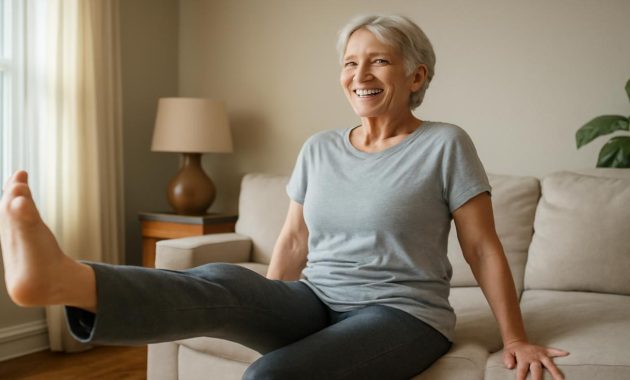
The woman in the blue jacket pauses at the edge of the park path, watching the young runners stream past like a river of neon shoes and earbuds. Morning mist hangs low over the grass. Somewhere, a dog barks; somewhere closer, her waistband pinches. She presses a palm lightly against her belly—soft, familiar, frustrating. She’s 67, walks nearly every day, eats “pretty decently,” and yet that ring of abdominal fat clings like an old memory. Her doctor calls it “visceral fat.” She calls it the thing that makes every mirror feel a little too honest.
She’s tried planks. She’s tried crunches. She’s flirted with yoga videos and half-finished fitness challenges. But her back complains, her knees protest, and most of what the gyms offer seems designed for people who still talk about “leg day” and “glute gains.” At her last check-up, she finally asked the question that had been simmering inside her for years:
“Is there one exercise that actually works for this belly—at my age—that I can actually stick with?”
Her doctor smiled, leaned back, and said something that surprised her: “Yes. And I’m almost certain you’re not doing it.”
The quiet villain: why abdominal fat changes after 60
Abdominal fat after 60 isn’t just “a little extra around the middle.” It’s a storyteller, whispering about hormones, habits, and time itself. For many people, especially women around and after menopause, fat seems to migrate inward, moving away from hips and thighs and settling stubbornly around the abdomen.
Inside, it’s not just the familiar soft layer you can pinch. There’s visceral fat, wrapped around organs like the liver and intestines—out of sight, but not out of trouble. Experts connect this hidden fat with a greater risk of heart disease, type 2 diabetes, and higher blood pressure. You can’t always see it in the mirror, but your body certainly feels it.
After 60, several things shift at once:
- Muscle mass naturally declines, which slows your metabolism.
- Hormones change—especially estrogen in women and testosterone in men—which alters where fat prefers to settle.
- Daily movement usually drops: fewer stairs, more sitting, more screens, less walking without realizing it.
Diet matters, of course. So does sleep, stress, and genetics. But beneath all of that is one powerful, often overlooked lever that experts keep circling back to—something both simple and oddly radical in its ease.
The expert favorite you’re probably not doing
If you’re picturing a complicated machine at the gym, you can let that go. The exercise many geriatricians, cardiologists, and exercise physiologists quietly champion for shrinking abdominal fat after 60 is something older than gyms, older than sports, older than almost everything we call “exercise.”
It’s brisk walking.
Not wandering slowly through the grocery store. Not strolling while scrolling through your phone. Brisk walking—on purpose, with a little intent behind it. The kind that slightly shortens your breath but still lets you talk. The kind that brings a gentle warmth to your cheeks and a rhythm to your thoughts.
To many people, it sounds too simple to work. We’ve been trained by decades of fitness marketing to believe that better results require more complexity, more equipment, more sweat, more pain. But experts who work specifically with older adults tend to say something very different: the exercise you actually do, consistently, almost always beats the “perfect” exercise you never start, avoid, or quit.
And when it comes to abdominal fat and metabolic health after 60, brisk walking sits in a sweet spot:
- It raises your heart rate enough to tap into stored fat over time.
- It is gentle on joints compared to running or high-impact aerobics.
- It doesn’t require equipment, training, or a membership.
- It’s incredibly adaptable—you can do it indoors, outdoors, alone, or with friends.
The woman in the blue jacket had been “walking” for years—but not quite like this. Her kind of walking was more sightseeing than exercise: pleasant, but rarely sustained, rarely challenging, and easily interrupted by phone calls, errands, or a sudden drizzle. What changed her belly wasn’t the idea of walking; it was learning how to walk like it mattered.
How brisk walking actually targets belly fat
Imagine your body as a quiet, patient system that responds to patterns, not promises. Brisk walking creates a particular pattern—moderate, sustained activity—that your body interprets as a reason to mobilize stored energy.
Here’s what experts highlight about its effect on abdominal fat specifically:
- It improves insulin sensitivity. Better insulin function helps your body handle blood sugar more efficiently, reducing the constant “spike and crash” pattern that encourages fat storage around the middle.
- It nudges your body to use fat for fuel. During moderate-intensity activity done long enough, your body gradually increases its reliance on fat as an energy source, especially when repeated regularly.
- It calms stress chemistry. Chronic stress raises cortisol, a hormone strongly linked with belly fat. Rhythmic walking—especially in nature—has been shown to lower stress levels, supporting a healthier waistline over time.
- It protects and builds lean muscle. You won’t grow big muscles from walking, but you will keep the ones you have working. Muscles burn more energy than fat, even at rest, helping guard against age-related metabolic slowdown.
The twist? You don’t have to turn your life upside down to get this effect. What matters most is consistency and intensity that’s right for you.
Finding your “brisk” pace, without a heart-rate monitor
For someone in their 60s or 70s, brisk doesn’t mean panting, sweating buckets, and checking a watch every two minutes. A classic rule many experts use is the “talk test.”
- You can speak in short sentences.
- You can’t sing.
- Your breathing is noticeable but not uncomfortable.
That sweet spot—where conversation is possible, but not effortless—is the zone where abdominal fat and heart health both start to shift in your favor. It’s the place where the walk stops being just “going somewhere” and starts becoming medicine.
Designing the easiest routine you’ll actually follow
There’s power in tiny, almost insignificant-seeming choices that add up over months. The woman in the blue jacket didn’t start with heroic goals. She started with seven minutes.
Her doctor suggested a structure that many experts use with older adults: simple, repeatable, flexible. She wrote it on a sticky note and put it by her front door:
- Walk 5–7 days per week.
- Start with 10–15 minutes at a pace that feels “purposeful.”
- Add 5 minutes every week or two, as long as it feels safe.
- Work gradually toward 30–40 minutes on most days.
She added one more line herself: “A little is infinitely better than none.”
Over the next few months, she turned that sticky note into a ritual. Some days, she walked through the park, trees catching early light on their leaves. Some days, it was just loops around her block because the weather was sour and her mood was sourer. A few days, she only managed eight minutes. On others, she looked up and realized she’d gone forty.
Below is a sample week that many experts consider a realistic and effective starting pattern for older adults looking to reduce abdominal fat:
| Day | Brisk Walking Time | Intensity Guide | Notes |
|---|---|---|---|
| Monday | 15–20 minutes | Comfortably hard, talk in short phrases | Focus on posture and arm swing |
| Tuesday | 15–20 minutes | Same as Monday | Try a slightly different route |
| Wednesday | 20–25 minutes | Add 2–3 minutes a little faster | Notice breathing, stay below panting |
| Thursday | Rest or easy 10-minute stroll | Very light, can chat easily | Treat as a recovery day |
| Friday | 20–25 minutes | Comfortably hard again | Walk with a friend if possible |
| Saturday | 25–30 minutes | Steady, purposeful | Enjoy a scenic route or park |
| Sunday | Optional 15–20 minutes | Moderate, adjust to how you feel | Reflect on wins from the week |
Over time, you can gently stretch those 20–30 minutes toward 40 or even 45 if it feels comfortable and approved by your healthcare provider. But the magic isn’t just in the minutes. It’s in the rhythm of showing up, again and again, teaching your body that movement is part of who you are now.
The small tweaks that double your results
Brisk walking alone can make a real dent in abdominal fat, but a few subtle additions can quietly multiply its impact—without turning your life into a boot camp.
Add light strength: two days a week, 10 minutes at a time
Experts increasingly repeat a simple refrain: “Muscle is medicine.” After 60, pairing walking with even a little strength work can further reduce abdominal fat and improve posture, balance, and daily energy.
You don’t need weights or machines to begin. Twice a week, after a walk or on a separate day, you might try:
- 2–3 sets of gentle sit-to-stands from a chair.
- Wall push-ups or countertop push-ups.
- Standing heel raises while holding a chair back.
- Simple marching in place for 30–60 seconds.
Each of these strengthens the large muscle groups that support your core and lower back, helping your body hold itself differently, burn energy more efficiently, and move with more confidence.
Turn some walks into “intervals” without scaring yourself
The word “intervals” sounds like something track athletes do in tiny shorts. For older adults, it can be as gentle as this:
- Walk at your normal brisk pace for 2 minutes.
- Speed up slightly for 30–60 seconds—just enough to feel your breath deepen.
- Return to your usual brisk pace for 2 minutes.
- Repeat this pattern a few times.
These tiny, manageable surges of effort can boost cardiovascular fitness and calorie burn without overwhelming your joints or your confidence. Many people find them surprisingly fun—like moments of play hidden inside a familiar routine.
Making it joyful: turning a prescription into a pleasure
What keeps most people from continuing exercise isn’t ability. It’s boredom, loneliness, and the quiet weight of “should.” Brisk walking, if you allow it, can become something else entirely: a small daily ceremony, a moving meditation, even a social anchor.
One man in his early 70s started walking at sunrise, partly for cooler temperatures, partly because his evenings were always busy. He began to notice tiny things he hadn’t seen in decades: the way the light slid across different houses, the regular appearance of a cat in the same driveway, the slow seasonal shift of leaves. He started saying hello to the same dog-walkers, then trading names, then swapping stories.
After a few months, the visits to his belt buckle told one story—holes gained instead of lost. His doctor said his blood pressure looked better than it had in years. But the deeper story was this: he looked forward to his walks. He felt less like he was fighting his body and more like he was accompanying it somewhere.
There are countless small ways to make brisk walking stick:
- Pair it with something you enjoy. An audiobook, a favorite podcast, or a playlist of songs from your youth can transform 20 minutes into a time you genuinely anticipate.
- Recruit a walking partner. Conversation makes time slip by, and appointments with another person are harder to cancel than appointments with yourself.
- Walk in beautiful or interesting places when you can. A park, a quiet street with old trees, or even a large indoor mall on bad-weather days can add a sense of exploration.
- Keep your expectations humane. Not every walk will feel great. Not every week will go as planned. The power lies in coming back, gently, again and again.
Abdominal fat may be part of your story after 60, but it doesn’t have to be the final word. A simple, regular walk—brisk enough to remind your heart it’s alive, gentle enough to repeat tomorrow—can slowly re-write what your body carries and how it feels to live inside it.
When to be cautious—and why it’s always okay to go slower
Before starting or intensifying any exercise routine after 60, especially if you’ve been mostly sedentary or have health conditions, experts strongly recommend talking with your healthcare provider. That conversation isn’t a barrier; it’s a bridge.
If you experience chest pain, severe shortness of breath, dizziness, or pain in your legs or joints that doesn’t ease when you slow down, that’s your body asking for a different approach. Sometimes the answer is physical therapy, different shoes, shorter walks, or smoother surfaces. Sometimes it’s testing to make sure your heart and lungs are ready for the journey you’re about to begin.
Starting “too small” is rarely a problem. The woman in the blue jacket began with a single lap around the block. It felt almost silly. But silly became familiar, familiar became routine, and routine eventually reshaped not just her waistline, but her sense of possibility.
You don’t have to run. You don’t have to plank. You don’t have to do burpees or buy gadgets or memorize complicated moves. You only have to put one foot in front of the other, a little faster, a little more often, and trust that in the quiet repetition of your steps, your body is listening, adjusting, and—slowly, stubbornly—changing.
FAQs: Abdominal fat after 60 and brisk walking
How many days a week should I walk to reduce belly fat after 60?
Experts generally recommend aiming for brisk walking on most days of the week, ideally 5–7 days. Even 10–20 minutes can help, especially when you build toward 30 or more minutes over time.
Can I break my walking into shorter sessions and still see results?
Yes. Three 10-minute brisk walks spread throughout the day can be nearly as effective as one continuous 30-minute walk. The key is maintaining a purposeful pace during each segment.
Will walking alone flatten my stomach?
Walking can significantly reduce abdominal and visceral fat, but a completely flat stomach may not be realistic or necessary, especially with age and natural body changes. Pairing walking with mindful eating, good sleep, and light strength training usually brings the best results for both health and appearance.
Is it too late to start if I’m over 70 or 80?
No. Research consistently shows benefits from starting regular walking even in your 70s, 80s, and beyond. Improvements in balance, mood, cardiovascular health, and waist circumference are seen across age groups, as long as activity is tailored to individual ability and medical guidance.
What if I have knee or hip problems?
If joints limit your walking, talk with your doctor or a physical therapist. They may suggest:
- Shorter walks on softer, flatter surfaces.
- Supportive shoes or orthotics.
- Alternatives like stationary cycling or water walking.
Many people find they can still walk briskly within their comfort zone once pain is addressed.
Do I need special shoes or equipment?
You don’t need anything fancy, but supportive, comfortable walking shoes make a big difference. Clothing that allows free movement and layers for temperature changes are also helpful. No gadgets are required unless you enjoy tracking steps or time.
How long before I notice changes in my waistline?
Everyone’s timeline is different, but many people notice changes in how their clothes fit and how they feel—less puffiness, better energy—in about 4–8 weeks of consistent brisk walking. More visible changes in waist circumference often appear over 3–6 months, especially when combined with healthy eating.
Is walking after meals helpful for belly fat?
A short 10–15 minute walk after meals can improve blood sugar control, which in turn supports lower abdominal fat over time. Many experts now recommend post-meal walks as a simple, powerful habit for metabolic health at any age.