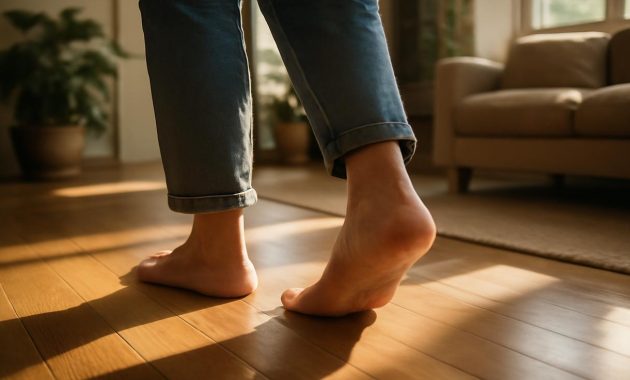
The first thing you notice is the temperature. Cool wood, just a shade colder than the morning air, presses up against the soft skin of your soles. You curl your toes, feeling for the faint grain of the floorboards, the tiny dip where one plank meets another. Somewhere down the hall, a kettle murmurs on the stove. Outside, a bird insists the day has already begun. And for a moment, you realize: you are not just standing in your house—you are in conversation with it, through the thin, brilliant sensitivity of bare feet.
The Quiet Awakening of Your Feet
Most of us spend our days with our feet padded, propped, supported, or simply ignored. We lace them into sneakers, slide them into slippers, wedge them into formal shoes with stiff soles. Comfort, we tell ourselves. Protection, cushioning, arch support. But underneath all that fabric and foam live some of the most finely tuned sensors in your entire body.
Each foot carries thousands of nerve endings, constantly sending your brain updates: where the ground tilts, how slick the surface is, where the weight of your body is leaning. When you walk barefoot at home, these sensory channels open wide. Suddenly, your brain receives a detailed map of the floor beneath you—every subtle slope, every temperature shift, every texture change.
At first, this can feel almost too vivid. The tile in the kitchen is shockingly cold; a forgotten crumb pokes the arch of your foot; the weave of the living-room rug feels strangely scratchy. But beneath that initial rush of sensation, something quieter and more important starts to happen: your balance system wakes up.
Balance is not a single skill you either have or don’t. It’s a living relationship between your eyes, your inner ear, your muscles, and those underrated experts, your feet. When you walk barefoot, your brain is given better data about what’s happening under you, and it responds by fine-tuning the way your muscles engage. Over time, this richer feedback loop can mean steadier steps, fewer stumbles, and a subtle but real shift in the way you move through your own home.
The Science Beneath the Skin
Imagine your body as a constantly adjusting tripod. One leg is your visual system—eyes scanning the world, noting furniture edges, stair heights, and the distance to the next doorway. The second leg is your vestibular system, hidden deep in your inner ear, sensing motion and head position. The third is proprioception: your body’s uncanny ability to know where its parts are in space without looking.
Proprioception is where bare feet shine. Within your joints, muscles, and skin are tiny receptors, like microscopic reporters, sending a steady stream of updates back to your brain. “Ankle tilting, left.” “Pressure increasing under the outer edge of the big toe.” “Heel landing a fraction too hard.” With bare feet, those messages are clearer and more frequent.
Shoes, especially thick, cushioned ones, tend to blur these signals. It’s a bit like listening to an orchestra through a wall: you can hear the general melody, but the fine details get lost. When you remove the barrier and go barefoot, the full symphony reaches your nervous system. The result is better coordination between feet, ankles, hips, and core. Tiny stabilizing muscles, often underworked, spring back into action.
What does that mean in everyday reality? It might be as simple as catching yourself more quickly when you accidentally step on a slightly rolled-up rug edge, or instinctively tightening through your ankle and hip as the dog’s toy rolls underfoot instead of awkwardly stumbling. Over weeks and months, those micro-adjustments add up to a quieter kind of confidence in your body—the kind you may not notice until you realize how rarely you wobble anymore.
The Hidden Workout Your Feet Have Been Missing
Think of a foot wrapped in a thick sole, then wrapped again in a plush carpet, then softened yet again by a memory-foam insole. It’s like putting your body on mute. The muscles along the arch get a little lazier. The small stabilizers around the ankle leave most of the work to the big leg muscles. The toes, cramped in a narrow toe box, forget their job as miniature anchors and balancers.
Going barefoot at home gently reverses that trend. Each step becomes a tiny exercise session for your feet:
- Your toes spread to grasp and adjust, especially on rugs or textured floors.
- Your arches learn to rise and fall with motion, instead of being locked into one supported position.
- The muscles around your ankles fine-tune the angle and pressure of each landing.
The beauty is that this “workout” requires no equipment, no sweat, and no special time carved out of your day. You practice it while making coffee, watering plants, walking to the bathroom at night, or watching a show from the kitchen counter. You simply remove your shoes and let your home become, quietly, a training ground for better balance.
How Home Becomes a Balance Studio
Think about the variety of surfaces in your house or apartment. The smooth coolness of kitchen tiles, the spring of wood or laminate, the soft give of rugs, the slight lip of a threshold. Each surface asks your feet a different question—and each answer teaches your body how to stay upright in the wider, messier world outside.
Walking barefoot across these subtle terrains turns an ordinary day into a low-key balance practice. On tile, your feet learn about slickness and the importance of precise placement. On hardwood, they sense the micro-slopes and dips that your eyes never notice. On a fluffy rug, they recruit more muscles to prevent sinking and sliding.
Over time, you might notice that you automatically shorten or lengthen your stride depending on what’s under you, or that you instinctively place your weight more carefully at the top of a staircase. These are signs that your brain is integrating richer information from your feet into every movement decision.
Even small, habitual paths—bedroom to kitchen, sofa to front door—become opportunities for nervous-system training. Maybe there’s a wobbly floorboard that always creaks or a rug fringe that your foot brushes past. Barefoot, your body catalogs these landmarks and weaves them into a constantly updating map. This map is the foundation of smoother, more confident balance.
Creating Gentle Challenges in Your Space
You do not need to turn your living room into a gym to gain these benefits. But with a little intention, you can nudge your environment to support better balance:
- Place a textured mat near the sink where you often stand to wash dishes.
- Let one small area of your home remain rug-free so your feet experience firm, smooth ground.
- Stand barefoot on one leg while brushing your teeth, switching legs halfway through.
- Walk heel-to-toe down a hallway a few times a day, feeling each segment of your foot as it lands.
All of this works best, of course, when your feet are free to feel what they’re doing. Bare skin on floor. Toes unconfined. Ankles unhindered by thick padding. Over months, the home you already know so well becomes the quiet studio where your balance is rebuilt, step by soft step.
Listening to Your Feet: Safety, Pain, and Pace
As comforting as the idea of barefoot living at home can be, it’s also natural to have reservations. Maybe the floor feels too cold. Maybe your feet ache when you stand without support. Maybe you worry about stepping on something sharp or aggravating an old injury. All of these are valid concerns, and they’re part of the story.
Walking barefoot doesn’t have to be an all-or-nothing decision. In fact, it shouldn’t be—especially if you’ve spent years relying on thick, cushioned shoes. Like any new movement practice, it’s kinder to start slowly and gradually expand your comfort zone.
Starting Gently, Without Overwhelming Your Body
Think of barefoot time as a training dose: small, consistent, and respectful of your current abilities. You can begin by simply removing your shoes for ten minutes in the evening while you move about the kitchen, or by padding barefoot from bedroom to bathroom in the morning. Notice what your feet tell you. Fatigue? A pleasant stretch? Sharp pain?
If standing on harder floors bothers you, try barefoot on a rug first. If even that feels too intense, consider thin, flexible socks or minimalist home slippers as an in-between step. The goal is not to suffer through discomfort; it is to reawaken your feet within the range they can tolerate, then gently invite them to do a little more over time.
People with specific conditions—like diabetes with reduced sensation in the feet, severe arthritis, or a history of foot ulcers—should be especially cautious. For them, the idea of being barefoot at home might not be appropriate without personalized medical guidance. In those cases, a compromise such as thin, flexible footwear indoors can still allow some of the sensory benefits while providing protection.
For many others, though, the biggest risk is not danger but impatience. Your feet and ankles may need weeks or months to build strength and stability. During that time, your job is to listen, adjust, and let the process remain gentle. Balance is not a sprint; it’s a relationship you’re rebuilding with your body.
What Changes Over Time: From Hesitant Steps to Quiet Confidence
The first week you go barefoot more often at home, you might simply notice intensity. The texture of the doormat. The way your heels thud more loudly than you expected. A little ache in the muscles along your arches. You may even feel clumsy at first, as if you’ve taken off a protective costume and revealed something softer underneath.
Then, with slow regularity, the changes begin. Your toes start to spread naturally when you stand, offering a wider, more stable base. On tricky surfaces—a damp patch near the bathroom sink, a crooked threshold—you feel micro-adjustments in your ankles that weren’t there before. Your footsteps grow quieter because your body is learning to land with more control and less impact.
At some point, usually without your noticing exactly when, your sense of balance begins to feel different, not just at home but outside too. You might navigate an uneven garden path with less hesitation, or recover more quickly when someone bumps your shoulder in a crowded place. The subtle training written into those barefoot minutes in your kitchen and hallway has a way of following you beyond your front door.
There’s also a mental shift that often arrives along the way. Moving barefoot tends to bring your attention downward, into your body. You become more aware of how you’re standing when you wait for the kettle to boil; you catch yourself locking your knees or leaning heavily into one hip. Simply noticing these patterns can lead to quieter, more balanced posture overall.
| Barefoot Benefit | What You Might Notice at Home |
|---|---|
| Improved sensory feedback | You feel temperature, texture, and tiny slopes in the floor more clearly. |
| Stronger foot and ankle muscles | Less wobbling when you stand on one leg or turn quickly. |
| Better posture and alignment | You catch yourself standing more evenly on both feet. |
| More confident movement | Fewer minor stumbles around rugs, thresholds, and clutter. |
| Greater body awareness | A clearer sense of where your body is in space as you move. |
Making Barefoot Time a Daily Ritual
Balance improvements from walking barefoot aren’t driven by intensity; they’re shaped by repetition and consistency. The magic lies not in one ambitious afternoon of barefoot wandering but in the tiny rituals you weave into your day, almost without thinking.
You might choose a simple rule: no shoes in the bedroom, ever. Or a quiet morning habit: the first ten minutes after you wake are always spent barefoot, padding from room to room as you open curtains and start the coffee. Maybe evenings become your barefoot hours, a physical signal to your body that the workday is over and you’ve stepped back into your own life.
Because it’s so gentle, barefoot time is one of the rare practices that can fit easily into almost any schedule. There’s nothing extra to plan, no gear to buy, no class to attend. You’re already moving through your home; you’re simply choosing to do some of that movement as nature originally designed—bare soles on familiar ground.
Over months and years, these ordinary moments can become the quiet backbone of your physical resilience. Long after the latest fitness trend has faded, your feet will still be there, ready to anchor you, adjust for you, and tell your brain everything it needs to know about the world beneath you—if you let them feel it.
Letting Your Home Teach You to Trust Your Body
The house or apartment you live in now is probably not a mountain trail or a forest path. It’s a collection of rooms and corridors, corners and thresholds, favorite chairs and kitchen counters. But within that familiar space lies something surprisingly powerful: a training ground for trust.
Each barefoot step is a small act of faith in your body’s ability to sense, adapt, and recover. At first, it may feel like you’re just avoiding slippers. Over time, you may realize you’re also avoiding something else: the slow slide into untested, underused balance systems that only show their weakness when you slip, trip, or fall.
Instead, you practice. Softly. Daily. Quietly rewiring the web of nerves, muscles, and reflexes that keep you upright. You reconnect with the floor under your life—the one you’ve walked on a thousand times without really feeling it. And in that simple, old-fashioned act of going barefoot at home, you invite your balance to grow steadier, more responsive, and more deeply your own.
FAQ
Is walking barefoot at home safe for everyone?
Not always. People with diabetes-related nerve damage, severe circulation problems, a history of foot ulcers, or recent foot surgery should talk with a healthcare professional before spending significant time barefoot. For many otherwise healthy people, gradual, mindful barefoot time at home can be safe and beneficial.
How long does it take to notice balance improvements?
It varies. Some people feel more grounded and aware within a few weeks of regular barefoot time. Deeper changes in balance, strength, and coordination often unfold over several months of consistent daily practice.
My feet hurt when I stand barefoot. What should I do?
Start with very short periods on softer surfaces like rugs, and build up slowly. You can also use thin, flexible socks or minimalist slippers as an in-between step. Persistent or sharp pain is a signal to consult a medical professional, such as a physical therapist or podiatrist.
Can barefoot walking at home replace balance exercises?
It can be a powerful foundation, but it doesn’t have to replace targeted exercises. Structured balance drills—like single-leg stands or heel-to-toe walking—can complement barefoot time, especially for older adults or anyone with a history of falls.
What if my floors are cold or hard?
You don’t need to be barefoot all day. Try short, intentional barefoot sessions on a rug or mat, especially in warmer parts of the day. As your feet adapt, you may find that harder or cooler surfaces become more tolerable, but comfort should guide your pace.
Will walking barefoot at home strengthen my arches?
For many people, yes, gradually. Allowing the foot muscles to work more naturally can support healthier arches over time. However, if you have a specific condition like severe flat feet or plantar fasciitis, get personalized advice before dramatically changing your footwear habits.
Do I need special “barefoot” shoes to get these benefits?
At home, no. Your bare feet are enough. If you choose to explore minimal footwear outdoors, transition slowly, as your body may need time to adjust to less cushioning and support. Indoors, simply giving your feet regular, safe contact with the floor is a powerful place to start.