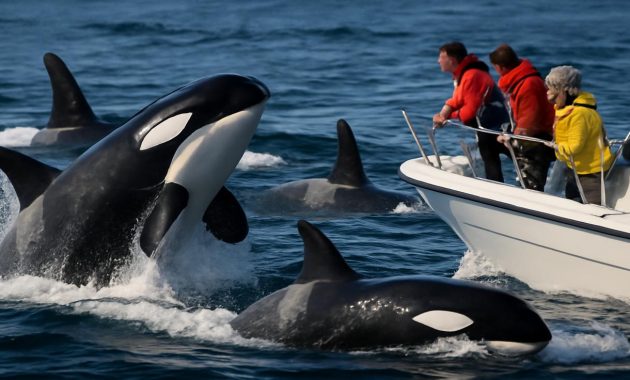
The first time a killer whale leaned its massive head against the hull of a sailing yacht off the Iberian coast, the crew reportedly thought it was a fluke—an odd, unforgettable encounter with one of the ocean’s most charismatic hunters. The whale slipped beneath the surface, rubbed along the fiberglass, then rammed the rudder with bone-deep force. The wheel spun in the skipper’s hands. Metal groaned. In minutes, the boat lay dead in the water, her steering gone. The sea was calm, the sky open and washed with late-day light, but something in the story had shifted—this was not the orca encounter sailors grew up dreaming about.
A Sea That Suddenly Felt Smaller
By late spring of recent years, reports like that one were no longer rare anecdotes passed around marina bars. They became patterns, charted in ink and pixel. Off the coasts of Spain and Portugal, sailors, fishermen, and pleasure cruisers began radioing in with trembling voices: groups of orcas were approaching their vessels, circling them, and—according to many accounts—striking rudders and hulls with unnerving precision.
On clear mornings, the Atlantic looks benign from a small boat. The air smells of salt and diesel, the wind scribbles bright flashes over the swell, and the rhythm of the water seems older and steadier than anything on land. But out there, beyond the view of beach umbrellas and boardwalk cafés, marine authorities were quietly revising their playbooks. Hydrophones captured unfamiliar patterns of calls. GPS plots marked clusters of interactions—most brief, some prolonged, a few alarming. A world that had always felt wildly vast suddenly felt close, crowded, and watched.
For generations, orcas have been framed as paradoxes: “killer whales” that seldom kill humans; apex predators with a disarming curiosity toward people and boats. Whale watch crews could read the sea the way farmers read clouds, trusting that if orcas approached, they would likely ride the pressure wave at the bow, spyhop, or simply ghost past. Now, that quiet assurance has eroded, replaced by a more unsettled question: what changed?
Patterns in the Swell: Are Orcas Really Becoming Aggressive?
Marine authorities tread carefully with words like “aggression.” Nature does not think in headlines, and animal behavior rarely folds neatly into human categories of good and bad. But the phrase has nonetheless appeared in official advisories, reports, and safety briefings: “increasingly aggressive behaviour toward passing vessels.” For those whose livelihoods depend on the sea, that wording lands heavily.
Sailors describe distinct episodes. A group of orcas appears near the stern, sometimes three, sometimes as many as a dozen. They surface in silence, exhale with the explosive sigh that always startles newcomers, and then fall into a pattern: nudging the rudder, circling, pushing sideways. Not every encounter is violent, not every group shares the same behavior. Yet enough rudders have been cracked, bent, or snapped that insurance brokers now recognize the pattern code before the claimant finishes the story.
Researchers tracking these encounters have begun to map incident details with methodical care—location, vessel length, time of day, sea state, wind, and outcome. They sketch orbits of black-and-white bodies around boat icons, each loop a reminder that orca societies run deep: matriarchs leading relatives, calves copying adults, adolescents experimenting with the boundaries of their underwater world.
For now, nobody is fully certain whether these are acts of play gone rough, targeted responses to past trauma, misdirected hunting behavior, or something layered and new. What’s clearer is that episodes are happening often enough that authorities have stepped in, urging caution, revising routes, and publishing guidelines like weather bulletins for a new kind of storm.
| Reported Factor | Common Pattern in Incidents |
|---|---|
| Location | Coastal waters off the Iberian Peninsula and nearby Atlantic routes |
| Targeted Area of Vessel | Rudders and stern sections more than midship or bow |
| Vessel Types | Primarily sailing yachts and smaller motor vessels; occasional fishing boats |
| Seasonality | Clusters in warmer months but not strictly limited to one season |
| Duration of Encounters | From a few minutes to over an hour, with intensity varying dramatically |
Warnings from the Shoreline: What Authorities Are Saying
In small coastal offices where the air smells faintly of coffee, paperwork, and wet rope, marine coordinators have been drafting bulletins that now ripple across radio frequencies and smartphone screens. The language is measured, but the message is clear: if you’re heading through certain corridors, you’re sharing them with orcas that may be far more interested in your boat than you are comfortable with.
Many authorities now recommend slowing to a crawl if orcas approach, cutting the engine if conditions are safe, and avoiding sudden changes of course that might be perceived as chase or flight. Some guidelines suggest steering toward shallower areas when possible, where orcas are less inclined to follow. Others emphasize not leaning over the transom, not attempting to touch or feed the animals, and resisting the modern reflex to film everything when adrenaline is already running high.
Harbor masters have begun to sound like a cross between meteorologists and wildlife rangers: “You’ll have a steady northerly breeze, moderate swell, and heightened orca activity along this stretch.” In some regions, recommended routes have shifted a few nautical miles offshore or inshore, bending around areas where repeated encounters occurred. Charts that once only marked reefs and sandbars now have digital overlays: polygons of “increased orca interaction reports,” as though the sea itself were updating its own terms of use.
Living with Risk on a Moving Edge
To long-distance sailors, risk is part of the deal. They accept storms, failures of gear, the strange solitude that settles in at 3 a.m. when you are the only person awake on a heaving deck. Yet there is something uniquely disquieting about a risk that surfaces with intent, breathes, and looks back at you with eyes that seem to measure, calculate, and remember.
Marine agencies have therefore tried to strike a delicate balance—alerting without demonizing, preparing without inciting fear. These animals are protected in many jurisdictions, recognized both as charismatic megafauna and as crucial apex predators sculpting the ecosystems that so many coastal economies depend on. The message is not “enemy ahead” but “mindful coexistence required.”
Inside the Orca Mind: Curiosity, Culture, or Something Darker?
To even begin interpreting these vessel encounters, you have to accept a simple but unsettling premise: orcas live complex social and cultural lives that extend far beyond the frame of a single incident. They teach, imitate, remember, and occasionally develop what scientists call “fad” behaviors—actions that sweep through a group, rise in popularity, and eventually fade, much like trends in human societies.
In some populations, orcas have carried dead salmon on their heads like hats. In others, they’ve played with kelp or deliberately created waves to wash seals off ice floes. Tool use, cooperative hunting, and detailed vocal dialects all point toward rich internal worlds. And when such a society develops a repeated behavior around boats, the question is no longer just “why did this whale do this?” but “what is this community learning from one another?”
Possible Explanations Scientists Are Exploring
While no single answer satisfies every reported incident, several main ideas recur in scientific discussions:
- Play and Exploration: Rudders move. They vibrate, spin, and resist. For a powerful predator used to manipulating live, struggling prey, a swinging blade of fiberglass or metal might simply be a fascinating new toy—something that kicks back.
- Trauma or Negative Association: Some researchers wonder if a few individuals had painful or frightening encounters with fishing gear or vessels—entanglement, collision, loud underwater noise—and began responding defensively to boats, a response then copied by close relatives.
- Foraging Confusion: Underwater, the acoustic signature of a vessel and its rudder could, in some contexts, resemble aspects of prey movement. Young orcas learning to hunt may experiment and refine, occasionally at the expense of a yacht’s steering system.
- Social Bonding and Shared Behavior: Even if the original trigger was play or trauma, the way the behavior spreads may be driven by social learning: calves following mothers, siblings copying older juveniles, a kind of cultural echo.
Each explanation carries its own implications. If this interaction is mostly play, it may fade as quickly as it appeared. If it’s rooted in negative experiences with vessels, it may harden into a tradition of resistance—a kind of slow cultural scar spreading through orca society.
A Predator That Doesn’t Forget
There is a chill in realizing you are being observed and categorized not just as a shape in the water but as a repeating feature of an orca’s world. Stories from fishers in other regions describe whales that recognize specific engine sounds, following certain boats more than others, or adjusting their tactics when humans alter routines. This is not the blank, indifferent wildness of a storm; this is a living intelligence reacting to what we do.
Marine authorities, cognizant of this, often emphasize reducing stressful interactions wherever possible. Avoid chasing orcas, they say. Keep a respectful distance. Follow established whale-watching guidelines. Because every encounter is not just an isolated spectacle—it is a lesson written into the memory of a group that might pass it down for decades.
On Deck with the Unknown: The Human Side of the Encounters
Imagine standing at the wheel of a thirty-five-foot sailboat when the first orca surfaces. You hear it before you see it—a deep, hollow exhalation just off the stern. Then the sound of water shearing off a dorsal fin taller than your own torso. The air suddenly feels thinner. Everyone on board rushes aft, hands wrapping around guardrails and stay wires. Cameras are raised, then slowly lowered as the mood shifts from awe to unease.
Another whale appears. Then a third. You can track their bodies even when they’re submerged, dark shapes rising and fading under the waves. The boat’s rudder shudders as something solid hits it from below. The wheel jerks under your hands, then begins to spin freely. Someone swears. Someone else starts whispering—half prayer, half self-reassurance. The engine is still running, but without steering you are adrift, a cork in a living current.
For many crews, these minutes stretch into strange, elastic time. They talk quietly, reassure each other, replay every instruction they’ve read or heard: stay calm, avoid sudden movements, don’t bang on the hull, don’t retaliate. Eventually, the orcas peel away, their white patches bright as lightning under the surface, and the sea settles into its familiar, indifferent roll. Yet the psychological wake lingers long after the rescue tow lines are cast, long after the insurance forms are filled in.
Rewriting the Story of “Killer Whales”
Human culture has always cast orcas in dramatic roles: monstrous predators in old sailor myths, show-business stars at marine parks, beloved mascots of whale watch brochures. The newer story—of orcas approaching vessels with force and intent—sits uneasily alongside environmental campaigns that have spent decades rebranding them as gentle giants of the deep.
But perhaps that discomfort is a sign we’re moving toward a more honest relationship. Orcas are not monsters, and they are not mascots. They are powerful, opportunistic, socially complex hunters sharing changing seas with us. Recognizing their capacity for unpredictable, sometimes dangerous behavior is not a betrayal of conservation; it is part of respecting who they truly are.
Learning to Share a Changing Ocean
Underneath the immediate drama of these encounters is a broader, slower story: the ocean itself is not the same ocean of a generation ago. Fish stocks shift as waters warm. Shipping traffic increases. Underwater noise swells. Chemical traces of human life seep everywhere—from coastal estuaries to remote deep channels. In that churn, animals adjust, experiment, and sometimes push back in ways we struggle to interpret.
Marine authorities issuing warnings about orcas are not only responding to a set of discrete incidents; they are also acknowledging that our relationship with the sea is becoming more entangled, more negotiated. The era of assuming the ocean will absorb our presence without consequence is ending. These whales are, in a sense, messengers of that shift—reminders that our machines, our routes, our noise, and our risks are now woven into the living fabric of ocean cultures.
Practical Guidance for Those Who Venture Out
For sailors and boaters planning passages through areas of heightened orca interaction, the emerging guidelines form a new kind of seamanship—one that blends traditional navigation with wildlife etiquette:
- Stay Informed: Check recent reports from local maritime authorities before departure, just as you would a weather forecast.
- Adjust Your Route: When possible, plan courses that skirt zones with repeated interactions, especially if you are on a small, lightly built vessel.
- Prepare Your Crew: Brief everyone on what to do and not do if orcas appear. Clear instructions reduce panic and impulsive behavior.
- If Approached: Slow down, avoid erratic maneuvers, and minimize noise. Do not throw items in the water or attempt to scare the whales away.
- After an Incident: Report it to the relevant authorities. Each account helps refine understanding and future guidance.
These are small acts of humility in a realm we have long treated as a blank canvas for our journeys.
Between Fear and Wonder
The sea at dusk has a way of blurring categories. The sky fades, navigation lights blink on, and reality feels slightly thinned, as though everything—boat, body, and water—were part of one restless element. In that half-light, the sight of a tall dorsal fin slicing across a swell can still send a thrill through even the most seasoned navigator. Orcas remain, overwhelmingly, symbols of wild majesty, proof that some grand narratives of the natural world are still being written far from city lights.
Yet woven into that wonder is now a thread of caution. Marine authorities will likely continue to issue their warnings as long as the pattern holds: keep your distance, respect their space, and be ready for encounters that are not scripted or safe. The ocean, gently but insistently, is reminding us that coexistence is not an abstract ideal; it is a daily practice, improvised at the edge of the unknown.
Out there, where the continent falls away and the depth sounder begins to whisper large, round numbers, our vessels are brief interruptions in lives that span decades and hundreds of miles. The orcas that nose at rudders today may remember the shapes and sounds of our boats long after our own logbooks have yellowed and flaked. Whether they are playing, protesting, or simply exploring, they are forcing us to meet them on more equal terms: not as backdrops to our adventures, but as neighbors with their own stories, choices, and, perhaps, grievances.
Standing at the rail, listening for that explosive breath in the dark, we are left with both unease and awe. The warnings from shore are real, practical, and necessary. But so is the invitation carried on every swell: to see these encounters not only as threats, but as chances to rethink what it means to travel respectfully through another species’ living, thinking world.
Frequently Asked Questions
Are orcas intentionally attacking boats?
It is not yet clear whether the behavior is best described as intentional aggression, intense play, or a mix of both. Orcas are highly intelligent and social; many scientists believe they may be experimenting with or reacting to boats rather than “attacking” in a human sense. However, the damage to rudders and the frequency of incidents have led authorities to treat the behavior as potentially dangerous.
Is it still safe to sail in areas where warnings have been issued?
Many vessels continue to travel safely through these regions every day, but the risk of an encounter is higher in certain hotspots. Authorities recommend staying informed about recent reports, adjusting routes when possible, and following safety guidelines if orcas appear. Preparedness and awareness significantly reduce the chance of panic or injury during an encounter.
What should I do if orcas approach my boat?
Current guidance often includes slowing or stopping the boat if conditions allow, avoiding sudden course changes, minimizing underwater noise, and keeping people away from the stern and waterline. Do not attempt to touch, feed, or scare the whales, and report the encounter afterward to local marine authorities.
Are people being injured in these incidents?
Most reported encounters involve damage to boats rather than physical harm to people. However, any time a vessel loses steering or propulsion, crews can be at risk from weather, waves, or secondary accidents. This is why authorities treat the issue seriously and stress prevention and calm responses on board.
Does this behavior affect orca conservation status?
The recent vessel interactions do not change the ecological importance of orcas or their need for protection. Many populations face threats from declining prey, pollution, noise, and habitat disturbance. While the incidents complicate how humans perceive these animals, conservation efforts remain focused on ensuring healthy, thriving orca populations and safer, more respectful coexistence at sea.