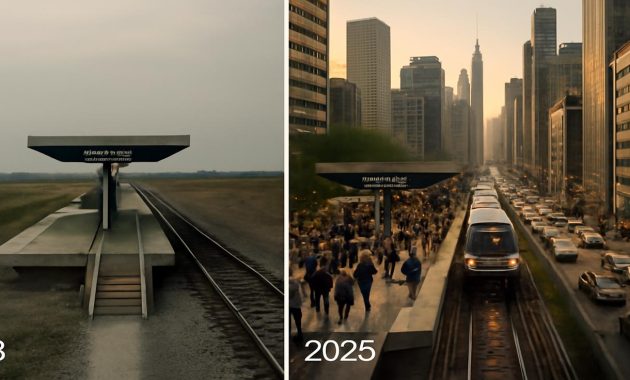
On a gray March afternoon in 2008, a train of yellow construction trucks crawled across an empty, windswept plain on the outskirts of a Chinese city most people outside the country had never heard of. There were no skyscrapers. No apartment blocks. No glassy malls or snaking traffic jams. Just muddy lanes, a few stray bicycles, and a collection of farmhouses watching from a distance as drills and cranes and steel beams arrived in a roar of engines.
In the middle of what looked, to anyone passing by, like nowhere at all, workers began to dig a hole—deep, square, and oddly precise. An old man in a blue jacket, standing with his hands behind his back, shook his head and muttered under his breath, “Who will ride this subway? Chickens?” His grandson laughed, eyes fixed on the excavator bucket crunching into the clay. The boy had never ridden a subway; he had only seen one in a cartoon.
By dusk the hole had taken shape. Wooden stakes marked the corners. Rebar sprouted from the earth like some alien crop. When the floodlights flicked on, turning the dirt into a stage, the emptiness around it seemed even more overwhelming. The workers smoked and shouted and hauled cables under the thin, cold rain. Beyond the glare, the fields dissolved into shadow—barely disturbed by the distant glow of a city that was still, for the moment, somewhere else.
Back then, if you had stood beside that old man and asked him what he thought, he might have told you the government was crazy. You can’t pour billions into tunnels and platforms where there are only farmers and stray dogs. You can’t build subway stations for people who don’t exist yet.
In 2008, it was easy to feel certain about that. By 2025, staring at the rush-hour crowds flooding through those once-lonely stations, it was just as easy to realize how wrong, and how naive, we’d been.
The Age of Empty Stations
China in 2008 felt like a country sprinting through history holding a roll of blueprints. Cranes multiplied across the skyline. Highways appeared in places that had been dusty tracks a year earlier. Whole neighborhoods vanished and reappeared as forests of concrete and glass. Still, even in a nation growing this fast, the newest subway lines seemed a step too far.
Journalists visiting new metro systems returned with the same stock photograph: a pristine station, all polished tiles and fluorescent lighting, containing nothing but a lone security guard and maybe one slightly bewildered passenger. Platforms hummed under the soft metallic whine of empty trains. Brand-new ticket machines blinked in the shadows, waiting for fingers that never came.
Online, those images went viral. Commentators scoffed at “ghost stations” and “phantom metros.” Western analysts wrote sharp columns about China’s “overbuilding” and “wasteful infrastructure binge.” Local skeptics made their own jokes, half amused and half anxious. “We’re building trains for the birds,” one popular saying went. “At least the sparrows will enjoy the air-conditioning.”
In city after city, entire lines seemed to snake into nothingness. Stations popped up in patches of empty land where weeds pushed through the cracks and temporary fencing rattled in the wind. You could emerge from a futuristic underground concourse only to be greeted by: silence, a couple of convenience stores, and a lonely bus stop facing a row of half-constructed apartment blocks.
To many observers, it felt like a symbol of reckless ambition. China’s cities, they said, were chasing status symbols. A metro system meant you had “arrived” on the world stage, whether you needed it or not. Why not just build a few bus routes and call it a day?
What almost no one outside the planning offices could see was that these stations weren’t mistakes. They were bets placed on a very particular vision of the future—a future that was already inching into existence, block by concrete block, just beyond the camera frames.
Blueprints for Ghosts: Planning for People Who Aren’t There Yet
To understand why China kept building subway stations in the middle of nowhere, you have to step into the quiet, fluorescent-lit world of the urban planners who designed them. Their windows overlooked not only the present but also a wall-sized map of the next twenty years.
On those maps, the empty fields were already gone. In their place: thick colored zones labeled with clinical optimism—“New Residential Cluster,” “Future CBD,” “University City.” Thin lines, some solid, some dashed, traced the routes of yet-to-be-built highways, ring roads, and metro lines. Sticky notes marked future schools, parks, and hospitals. The outskirts, to the planners, looked less like desolate fringes and more like a time-lapse waiting to be played.
China’s cities weren’t just growing; they were re-arranging themselves at a breathtaking pace. Rural land was being absorbed; factories were being pushed outward; millions were moving from villages to urban districts every year. If the planners had waited until the people arrived before building, it would have been too late. Congestion would choke the streets. Land prices would skyrocket. Tunneling under an already-dense neighborhood would cost two, three, four times more.
And so they did something deeply counterintuitive: they laid tracks in advance of footsteps.
Instead of following demand, they tried to anticipate it. They traced metro lines through planned housing districts before the first foundations were poured. They positioned stations beside fields that were already marked—on paper—for mega-malls, tech parks, and sports complexes. In many cases, the metro wasn’t responding to development; it was driving it. Developers would price luxury apartments by their distance to a station that, at the moment of sale, might still be a fenced-off construction pit.
Outside China, this approach often seemed bizarre. Urban transit, people argued, should be built “organically,” following the flow of existing neighborhoods. But in a country adding the equivalent of a large city every year, “organic” growth meant chaos. You either carved order into the landscape early, or you would spend decades untangling the resulting knots.
So the planners kept drawing lines into the empty spaces. The engineers kept digging. And the old man in the blue jacket kept asking: Who is all this for?
The Quiet Years Before the Crowd
Riding those new metro lines in the early 2010s could feel like stepping into a science-fiction film. You walked down gleaming staircases, past untouched advertising screens and spotless walls. The air smelled faintly of dust and metal and new plastic. The echo of your own footsteps accompanied you from the ticket gates to the escalator.
On the platform, the train slid in with a polite sigh. The doors opened with a chime. Sometimes, no one got off. You stepped into a car lined with empty seats, and for three, four stations, you had the space to yourself. Outside the window, the tunnels gave way to elevated tracks, and you glided past cranes, piles of sand and stone, half-finished roads, and grids of newly built towers standing mostly dark at night.
It was eerie and oddly moving. You could sense, in the quiet hum of the motors, the weight of a promise: this will not always be empty.
Not everyone believed it. Articles about “ghost cities” spread. Foreign television crews walked through nearly vacant plazas framed by brand-new apartment blocks and used them as evidence that the country had overreached. Look at all this emptiness, they said. No lights in the windows, no life in the courtyards. Just wind and stray dogs and a lonely metro station humming underground.
Yet if you came back a year later, the narrative would already be slipping. The stray dogs would be dodging delivery scooters. The empty shops would have hand-painted signs and stacks of plastic chairs waiting for customers. The station that had felt pointless now had someone selling steamed buns outside its entrance at 7 a.m., feeding construction workers hurrying to clock in on time.
Slowly, almost shyly, the population started to arrive: young couples rolling suitcases, grandparents carrying bags of vegetables, university students with headphones around their necks. At first they trickled. Then they streamed.
From Nowhere to Everywhere: 2025 and the Turning Point
By 2025, the satellite images told a completely different story.
Take one of those stations built in 2008 on the open plain. On a screen, you can slide a bar slowly across time. In the first image, a pale scar of construction cuts through fields and scattered huts. The station box is a faint, geometric shape at the edge of the city. There is nothing else.
Drag the bar a few years forward. Suddenly there are rows of mid-rise apartments flanking the line. A ring road curls around them like a question mark. Dark patches of land—future parks, perhaps—interrupt the grid with promise.
Slide again, closer to 2025, and the transformation is jarring. The area that once looked like the back of beyond has become a dense district in its own right. Towers crowd the horizon. School yards and basketball courts are rectangles of color amid the concrete. A shopping mall sits almost exactly where, back in 2008, the old man had stood shaking his head.
Stand there now, physically, and the sensory overload hits you before the memory can catch up. Taxi horns and bicycle bells. The metallic clang of a construction site still filling in the last gap between towers. The chorus of subway announcements leaking up through the stairwells. The smell of grilled skewers and coffee and car exhaust. The station, once a lonely experiment, is now the throat through which thousands of people pour every hour.
At 8:30 in the morning, the entrance is a steady flow of bodies. Office workers with ID cards swinging from lanyards. Students balancing backpacks and bubble tea. Parents tugging small children toward the escalators. One of those children—grumpy, half-awake—complains that the line is too long today.
Her grandmother laughs. “You should have seen this place when it was just mud,” she says. “Back then, there was no line. Because there was no one.”
The girl rolls her eyes, convinced this is just another adult exaggeration. How could there ever have been nothing here?
The Numbers Behind the Feeling
That sense—that a once-empty station has always been busy—is part of how quickly human memory rewrites itself. But the data is less forgetful.
In 2008, China had metro systems in a handful of major cities, and even those were relatively small. By the mid-2020s, more than forty cities were running subway or metro networks. Total operational track length more than quadrupled. What had been criticized as extravagance was now basic infrastructure for hundreds of millions of people.
Many of the most derided “middle of nowhere” stations matured into daily lifelines. Ridership numbers, once embarrassingly low, surged into the hundreds of thousands per day per line. The same commentators who had mocked “ghost metros” found themselves admitting, often quietly, that building ahead had not been the folly it seemed.
Consider a simplified snapshot:
| Year | Typical Outer-Suburb Station Surroundings | Average Daily Passengers (Outer Stations, Approx.) |
|---|---|---|
| 2008–2010 | Construction sites, fields, sparse housing | Few hundred to a few thousand |
| 2013–2016 | New apartment blocks, basic shops, schools planned | Several thousand to tens of thousands |
| 2020–2025 | Mature districts, malls, offices, dense housing | Tens of thousands to over one hundred thousand |
The table is crude, yes. Real numbers vary widely. But the pattern is unmistakable: where critics saw static emptiness, planners saw a moving timeline. The stations were not monuments to failure. They were seeds waiting for rain.
The Ecology of a Station
What exactly grows around a subway station, once it stops being an island in a field?
In the morning, the sidewalks fill first. Street vendors drag carts into position near the exits, frying dough sticks in oil that pops and crackles in the cold air. A line forms without anyone really deciding it should. Commuters hold paper bags that grow translucent with grease. The hiss of the fryer blends with the whoosh of air as trains arrive far below.
By midday, the shops that clung to the station’s edges—pharmacies, bubble-tea stands, tiny printing shops—are humming. A courier on an e-bike weaves through pedestrians, a stack of packages strapped dangerously high behind him. Office workers spill out for lunch, and the plaza becomes a living diagram of the neighborhood’s new ecosystem: young programmers with company badges; grandparents wheeling toddlers; students in matching school uniforms grabbing snacks before the next class.
At dusk, when the last orange light seeps between the towers, the station becomes a magnet for another kind of life. Musicians busk near the entrance, their guitar cases open like hopeful mouths. Retirees gather to dance in formation to old pop songs, the music echoing off the walls. Children chase each other up and down the low steps while parents keep half an eye on them and another half on their phones, timing their journey home to the minute.
It’s easy to forget, watching this swirl, that all of it is anchored to a piece of infrastructure that was once mocked as unnecessary. The ecology that wraps itself around a station—the shops, the habits, the daily rhythms of thousands—is not an accident. It’s a response to a hole someone decided to dig fifteen, twenty years ago, when there was nothing but bare soil and skepticism.
Why We Misread Empty Space
So why did we, in 2008, so confidently misunderstand what we were looking at?
Part of it is human psychology. We are naturally biased toward the visible present. Show us a shiny new station surrounded by fields, and we see only the contrast, not the trajectory. We’re quick to mistake “not yet” for “never.” Empty chairs look like a failed party, even if the guests are simply late.
Part of it is cultural. In countries where big projects are rare, where every piece of infrastructure is a battle of budgets and politics, the idea of building something far ahead of demand feels almost irresponsible. We’re used to transit arriving after frustration has boiled over, not before it starts. To see a government sink money into lines that won’t be crowded for a decade feels like fantasy—or hubris.
And part of it is that we tend to treat cities as static photograph frames, not as time-lapse films. We compare “then” and “now,” but forget about “soon.” Urban change, especially on the scale China has experienced, doesn’t move at a human walking pace. It sprints.
To be clear, not every bet pays off neatly. Some districts took longer than expected to fill. Some stations still feel quiet, or serve developments that never quite matched the initial promise. There were missteps, inflated expectations, and white elephants.
But surveying the landscape in 2025, it’s harder than ever to maintain the old certainty that building subway stations in the middle of nowhere was simply wasteful. Those ghost platforms have become arteries. The lonely escalators now carry the weight of a generation’s routine.
We weren’t just wrong about the stations. We were wrong about the speed at which a country can redraw its map, and about the value of preparing for life before it arrives.
The View from the Platform Edge
Imagine, for a moment, standing again with the old man in the blue jacket in 2008. The rain has thickened. The field is turning to mud. Machines growl as they chew their way deeper. The only other sound is the wind moving across the open land.
“They say there will be a station here,” he grumbles. “Who needs that? We have bicycles. We have buses from the town.” He gestures vaguely toward the distant city, its lights flickering through the drizzle. “There is nothing here.”
You, armed with what you now know in 2025, want to tell him: Wait. In ten years, your grandson’s school will be two stops away. The bus will be irrelevant. You’ll take this very line to a new hospital that hasn’t been drawn yet. The road behind you will turn into a six-lane avenue. The farmhouse in front of you will be replaced by a pharmacy. The field behind you will become a park where office workers eat lunch from cardboard boxes.
You want to say: The emptiness you’re looking at is not an argument against this station. It’s the reason it needs to exist first.
But of course, you can’t. Time only runs one way. So instead, you file away the scene in your memory, watch the steam rise from the workers’ instant noodles at lunchtime, and wait.
Years later, you stand in roughly the same spot, now tiled and polished, near the top of the escalators. The air smells less of wet soil and more of perfume, fried food, and too many people in a small space. The ceiling speakers murmur the next train’s arrival.
A digital sign flashes: “Train arriving in 2 minutes.” Underneath, in smaller text, it quietly lists a name: the name of this station, once a joke told in fields, now a fact woven into thousands of daily journeys.
In 2008, we saw only what was missing. By 2025, we began to understand that sometimes the bravest thing a society can do is to build for the people who are not there yet—and to trust that, in time, they will come walking down the stairs, swiping their cards, and filling the space that once seemed impossible to imagine.
FAQ
Why did China build subway stations in seemingly empty areas?
Planners were building for projected future demand, not current population. Many “empty” areas were already zoned for large-scale housing, business districts, and universities. Building the metro first helped guide development, control congestion, and reduce long-term costs.
Weren’t some of these stations a waste of money?
Some stations and lines underperformed in the short term, and a few still feel quiet today. But on the whole, many once-criticized “ghost” stations are now busy hubs. The strategy involved calculated risk: accepting some overbuilding in exchange for an integrated, future-ready network.
How fast did these areas fill up?
Timelines varied. Some stations saw significant ridership within three to five years as housing projects finished. Others took closer to a decade. Dramatic growth between 2010 and 2025 in many Chinese cities meant that what looked empty in 2008 was often dense by the mid-2020s.
Could other countries use the same approach?
In principle, yes—building transit ahead of demand can shape more sustainable, less car-dependent cities. But it requires strong coordination between land-use planning and transport, stable funding, and political willingness to invest in infrastructure that may look “underused” for several years.
What’s the main lesson from these “stations in the middle of nowhere”?
The main lesson is that cities are time-lapse organisms. Judging infrastructure only by its first few years can be misleading. Building early—before crisis-level congestion and sprawl—can be more efficient and transformative than constantly playing catch-up with growth.