The first time I watched someone walk themselves out of knee pain, I didn’t believe what I was seeing. No pool. No reformer machine. No careful, slow Pilates sequences. Just a narrow dirt path circling a city park at sunset, a middle‑aged man in a faded T‑shirt, and a pair of shoes that had clearly seen better days. He moved with the hesitant rhythm of someone who knew pain intimately, every step measured, shoulders tense, hand hovering near a bench as if he might need it. Yet with every lap, his gait loosened, his face softened, his hand left the bench and stayed by his side. By the fourth circuit he did something that made the physical therapist walking beside him grin like a kid: he picked up the pace. Not a jog, not even a power walk. Just a deliberate, weight‑bearing stroll—heel to toe, heel to toe—as if he were testing a wild idea: What if the thing that hurts could also be the thing that heals?
The surprising exercise that nobody wanted to believe
For years, knee pain had its usual cast of heroes. Swimming, with its gentleness and buoyancy. Cycling, with that controlled, circular glide. Pilates, with its deliberate core activation and precise alignments. These were the darlings of the medical handout, the trusted trio trotted out in waiting rooms and online advice columns: low‑impact, “joint friendly,” safe. If your knees complained, you were told to unweight them, coddle them, keep them out of harm’s way.
So when a cluster of physiotherapists and sports medicine doctors began whispering about a different prescription—one that involved standing up, bearing weight, and yes, occasionally gritting your teeth—the reaction bordered on sacrilege. They were recommending walking. Not casual, incidental walking between your car and the grocery store, but structured, progressive, load‑bearing walking designed not just to avoid damage, but to re‑educate the knee joint itself.
To the average person, that might sound almost disappointingly ordinary. Walking? Really? To some orthopedic surgeons and even a few rheumatologists, it sounded dangerous. “You’re telling people with worn cartilage to pound their joints more?” one specialist grumbled to a colleague at a conference. The word “reckless” was floated. “Experimental” was muttered. Yet the data, quietly accumulating in rehab clinics and research labs, suggested something bolder: under the right conditions, carefully progressed walking—and other deliberate weight‑bearing moves—might not only be safe for many types of knee pain, but transformational.
The anatomy of a medical argument
The war lines in this debate are not painted in neat red and blue. Instead, they crisscross between disciplines, philosophies, and even generations of clinicians. On one side are those who grew up in the age of “rest the joint, spare the cartilage.” Their mental image of a damaged knee is a fragile, eroding hinge: once worn, always vulnerable, like a rusty gate that squeaks louder every time you open it.
On the other side is a newer view of the knee as a living, adaptable ecosystem—a mix of bone, cartilage, ligaments, tendons, muscle, fascia, nerves, and blood supply that responds constantly to the forces it experiences. Too much force, delivered too fast, in the wrong way? Disaster. But the absence of force, it turns out, is its own kind of quiet catastrophe. Muscles weaken. Cartilage loses its nourishing squeeze‑and‑release cycle. Balance dulls. The nervous system becomes more sensitive to pain, less confident under load. The hinge metaphor gives way to something more like a forest: leave it unmanaged and untouched, and it doesn’t stay the same. It changes, and not always for the better.
This is where progressive weight‑bearing exercise struts in, not as a brutal test of toughness but as a carefully calibrated conversation with that ecosystem. “Motion is lotion,” one physical therapist likes to tell her patients, “but load is language.” The question is not whether to load the knee, but how, how much, and for how long.
The quiet revolution: walking as a treatment plan
In a small outpatient clinic tucked between a bakery and a laundromat, the revolution doesn’t look anything like a war. It looks like clipboards and sneakers and timers on phones. It looks like a woman in her sixties clinging nervously to a rail for her first two minutes of walking and then, three weeks later, laughing mid‑stride while she tells a story about chasing her grandson in the yard.
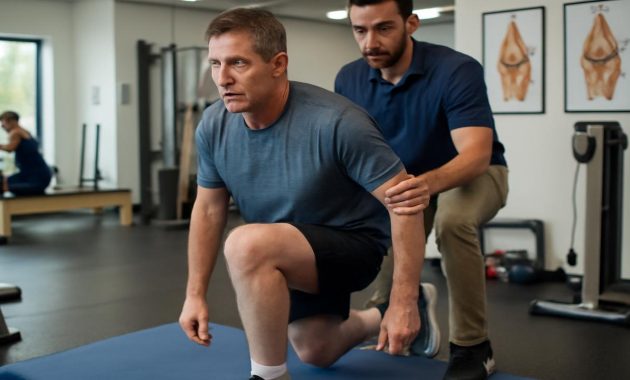
Her therapist, a compact man with gentle eyes and an intimidating grasp of tendon physiology, works from a simple framework. First: reduce the angry, flaring pain with gentle range‑of‑motion work, ice or heat, and activity modification. Then—sooner than many people are comfortable with—reintroduce weight in tiny, deliberate increments. Fifteen seconds of standing mini‑squats. A slow sit‑to‑stand from a chair with hands resting only lightly on the thighs. A walk down the clinic hall and back with a focus on stride, foot placement, and knee tracking.
He uses a pain scale, but not the old “zero or you’re failing” model. “If your pain during the activity stays around a three or four out of ten and settles back to baseline within a day, we’re in the green zone,” he explains. “We’re asking the joint to adapt, not begging it to forgive us.” What emerges over weeks is something that looks suspiciously like a hiking plan, scaled down and stripped of scenery: add a minute here, a second set there. Introduce mild hills only when the flat path feels easy. Pepper in short bouts of step‑ups onto a low platform, or controlled lunges that never let the knee dive past the toes.
To a passerby, it’s just walking. To the people who arrived clutching their knees with every movement, it’s a return to citizenship in their own bodies.
What weight-bearing really does inside the knee
If you could shrink yourself down and ride along inside a working knee during one of these walks, the scene would be anything but static. With each step, the femur and tibia press together and separate in a subtle rolling glide. Cartilage, that smooth white padding, doesn’t have its own direct blood supply; it depends on that rhythm of loading and unloading to suck in nutrients from surrounding joint fluid and push out waste. Think of it as a sponge that only freshens itself when it’s squeezed.
Muscles—the quadriceps in front of the thigh, the hamstrings in back, the calves below—are not just movers but active shock absorbers. When they contract under load, they take up some of the stress that would otherwise slam into joint surfaces. The stronger and more coordinated they are, the more gracefully they can share the burden. Even bone responds: mild, regular loading encourages it to maintain density, organizing and reinforcing itself along the lines of force.
None of this magic happens when you hover in a bubble of non‑weight‑bearing life. Swimming and Pilates still have important roles. They build control, mobility, and endurance without overtaxing tender structures. They can bridge you through a painful flare when every step feels like a negotiation. But if they become a long‑term refuge from gravity, they may unintentionally keep the knee in a kind of suspended animation—safer, but not necessarily better.
Why experts are split—and why patients are caught in the middle
Ask three knee specialists about weight‑bearing exercise and you might get three entirely different flavors of caution. One will tell you to avoid anything that makes the joint ache for more than a few hours. Another will insist that some discomfort is not only acceptable but essential for progress. A third will hand you a pamphlet with a generic routine and send you on your way, hoping it lands somewhere in the safe middle.
Behind their disagreement is a tangle of fears, experience, and evidence. Surgeons tend to meet knees at their worst—shredded ligaments, bone‑on‑bone arthritis, fractures that look like someone dropped a boulder on a delicate machine. They see what overload can do when it comes fast and furious. Rheumatologists deal in inflammation, autoimmunity, and the kind of searing pain that can make a light sheet feel like a weight. Physical therapists, on the other hand, often witness what happens when knees are babied for too long: stiff, weak joints that scream louder with less provocation.
The research literature complicates things further: some studies show that regular walking programs can reduce pain and improve function in many people with osteoarthritis. Others highlight that over‑enthusiastic increases in activity—too much, too soon—can provoke flare‑ups and discouragement. Layer on the reality that “knee pain” is not one condition but a hundred different stories—meniscal tears, tendinopathy, patellofemoral pain, post‑surgical stiffness, early arthritis, late‑stage collapse—and it becomes clearer why there is no single, tidy answer.
Still, a quiet consensus is growing: total avoidance of weight‑bearing for chronic, non‑acute knee pain rarely leads to better long‑term outcomes. Movement, especially progressive, attentive, load‑bearing movement, seems to do something that rest alone cannot—both in the tissues and in the brain’s relationship with pain.
Designing a knee-friendly walking habit
In that same clinic where the man in the faded T‑shirt circled the park, the therapist keeps a laminated chart in his office. It’s simple, almost childlike, but it has become a kind of diplomatic treaty between pain and progress.
| Phase | Goal | Typical Duration | Example Activities |
|---|---|---|---|
| 1. Calm the storm | Reduce sharp pain and swelling | 3–10 days | Gentle range of motion, short supported stands, basic quad activation |
| 2. Reintroduce load | Tolerate short bouts of weight‑bearing | 1–3 weeks | 1–5 minute walks, sit‑to‑stands, mini‑squats to a chair |
| 3. Build capacity | Increase strength and endurance | 3–8 weeks | 10–30 minute walks, step‑ups, light resistance exercises |
| 4. Return to life | Match or exceed daily life demands | Ongoing | Longer walks, stairs, light hiking, individualized sport prep |
The numbers are flexible. For some people, Phase 1 is a weekend; for others, it’s a month. The rule of thumb is simple: your knee is allowed to voice an opinion, but it’s not allowed to throw a tantrum. A little increase in soreness during or right after a walk? Acceptable. Swelling that balloons overnight, pain that spikes and stays elevated the next day? That’s the body’s way of slamming the brakes and demanding an adjustment—less duration, less intensity, or more support.
Shifting terrain becomes part of the story too. Flat, even paths first. Then slight inclines. Then, perhaps, the rough, conversational ground of a forest trail, where roots and rocks demand micro‑adjustments that slowly restore your knee’s confidence. All of it is weight‑bearing, but none of it is meant to be punishment. “We’re not here to prove how tough you are,” the therapist tells his patients. “We’re here to show your knee it’s not broken, it’s learning.”
Stories written step by step
Consider Lena, a 45‑year‑old graphic designer who once loved urban hikes the way some people love novels. Her favorite routes stitched together pockets of green across the city—river paths, forgotten staircases, community gardens hidden behind old warehouses. Then came the slow, insistent ache in her right knee, the way it amplified after long days at her desk. She did what many of us would do: she rested. Then she rested some more. She swapped her weekend walks for long baths and streaming shows. The pain dulled at first, then came back sharper when she tried to pick up where she’d left off.
By the time she landed in a sports medicine clinic, she’d been told by one clinician to “avoid hills forever” and by another to “just push through it, pain is weakness leaving the body.” Neither felt right. What she wanted was not bravado or protectionism but a map.
Her map started with five minutes. Not fifteen, not thirty. Five careful minutes of walking on flat ground at a pace that allowed her to talk without gasping, focus on her footfall, notice her alignment. Her instructions were clear: if her knee complained at a low simmer during those minutes and then simmered down afterward, she could add one to two minutes every few days. If it spiked into a roar, they would dial back and regroup.
Eight weeks later, she was taking forty‑minute walks on mixed terrain. Hills were back on the menu, not as an enemy ambush but as a negotiated truce. Her knee still talked to her—on damp days, after long hours in a cramped meeting room—but the tone had changed. Less alarm, more feedback. “It’s like my knee went from screaming ‘danger’ to whispering ‘hey, pay attention,’” she said. “And the walking is how we learned to speak again.”
Why this feels “shocking” — and why it might become normal
To people steeped in the old, fear‑based script about joints—“once it hurts, don’t use it”—the idea of deliberately prescribing weight‑bearing exercise for knee pain sounds like a plot twist written by a cruel author. But in the broader context of how the body heals, it’s not really shocking at all. Bones respond to load. Tendons remodel under tension. Muscles grow when challenged, not coddled. The immune system settles when it recognizes familiar, safe patterns of movement instead of bracing for catastrophe with every step.
What makes this approach feel radical is less the physiology and more the cultural baggage around pain. We are not used to being told that some measure of well‑regulated discomfort is not only acceptable but productive. We are not used to doctors saying, “Yes, it might ache a bit, and we’ll use that ache as information, not as a verdict.” We are certainly not used to the idea that something as ordinary as walking — the thing we do to fetch the mail or pace during an awkward phone call — could be prescribed with the same reverence as an advanced exercise class.
Yet behind the skirmishes in medical journals and conference halls, there is a growing sense that this might be the new normal. Lifestyle medicine, rehabilitation science, and pain neuroscience are converging on a simple truth: the human body is built for weight‑bearing. Completely removing that from the equation for a chronically sore joint rarely leads anywhere good.
Listening to your own knees in a noisy world
Meanwhile, the rest of us live far from the polished certainty of journal abstracts. We live in bodies that have to get to work, climb the stairs to bed, stand in line, bend to tie shoes, crouch to pull weeds. When those acts start to hurt, we’re bombarded with directives: Don’t run. Don’t squat. Only swim. Only do Pilates. Never do Pilates. You must strengthen. You must rest. It’s like being in a crowded room where everyone is shouting advice and your knees are the only ones who can’t get a word in.
In that room, the notion of a simple, progressive, weight‑bearing walk can feel like a whispered invitation to sanity. Not a magic cure, not a one‑size‑fits‑all solution, but a way to begin a quieter, more respectful conversation with the joint that carries you through the world. To accept it is to accept a kind of partnership: you move; the knee responds; you adjust; it adapts. Over time, the feedback loop becomes less about fear and more about capacity.
Is this the end of swimming, cycling, or Pilates for knee pain? Not remotely. Each has a place, like instruments in an orchestra. The controversy is not about whether those tools help but whether we’ve been too quick to exile gravity from the healing process. The shocking recommendation from a new wave of experts is not to abandon gentleness, but to redefine it. Sometimes, they argue, the kindest thing you can do for a sore knee is not to wrap it in metaphorical bubble wrap—but to take it for a walk.
FAQ
Is walking safe for all types of knee pain?
No. Sudden, severe pain after an injury, locking of the joint, or significant swelling can signal problems like fractures, major ligament tears, or loose bodies. Those require medical evaluation before starting weight‑bearing exercise. For many chronic, non‑acute conditions, however, carefully progressed walking can be beneficial when guided by a professional.
How much knee pain is “okay” during weight-bearing exercise?
Many clinicians use a 0–10 scale. Pain around 3–4 out of 10 during activity that returns to your usual baseline within 24 hours is often considered acceptable. Sharp, intensifying pain, or soreness that worsens and lingers beyond a day, is a sign to reduce intensity, duration, or seek advice.
Should I stop swimming or Pilates if I start a walking program?
Not necessarily. Swimming and Pilates can complement weight‑bearing exercise by building mobility, core strength, and cardiovascular fitness with low impact. Many people benefit from a blend: some non‑weight‑bearing work plus progressive walking and strength training.
What kind of surface and shoes are best for walking with knee pain?
Flat, even surfaces—like tracks, park paths, or sidewalks—are usually best at first. Well‑fitting shoes with adequate cushioning and support help distribute forces. Some people do better in slightly stiffer shoes; others in more flexible ones. If in doubt, a physical therapist or knowledgeable shoe specialist can help you choose.
When should I see a professional before trying weight-bearing exercise?
Seek an evaluation if you have severe or sudden onset pain, significant swelling, a recent traumatic injury, a feeling of instability or giving way, locking of the knee, fever or redness around the joint, or a history of major surgery. Also consider professional guidance if you’ve had knee pain for more than a few weeks without improvement.
Can weight-bearing exercise actually improve arthritis, or just manage symptoms?
Current evidence suggests that progressive weight‑bearing and strengthening can reduce pain, improve function, and potentially slow functional decline in many people with osteoarthritis. It may not “reverse” structural changes, but it can significantly improve how the joint performs and how you feel living with it.
How often should I walk if I’m using it to help my knees?
For many people, starting with short walks most days of the week works well—think 5–10 minutes daily, then gradually building up. Consistency is usually more important than occasional long sessions. Adjust frequency and duration based on your symptoms and professional advice.