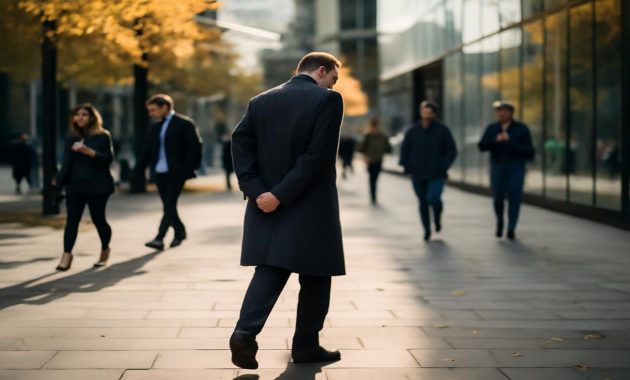
The first time I really noticed it, I was walking behind an old man on a tree-lined street in early autumn. His shoulders were slightly rounded, collar lifted against the breeze, and his hands were loosely clasped behind his back. His steps were unhurried, not lazy, but more like each footfall was tasting the ground. He paused now and then to study a window display, the veins of a leaf, the way a dog shook rain from its fur. People streamed around him—phones in hand, bags on shoulders, forward-leaning and urgent—while he moved as if time itself had widened around him.
I remember thinking: He looks like he’s thinking. Then a second thought arrived, darker and more reflexive: He also looks a bit… vulnerable. That odd mix of impressions—wisdom and fragility—stayed with me. Once I started to notice it, I saw it everywhere: the professor strolling across campus, the grandmother inspecting tomatoes at the market, the security guard on his late-night rounds, the teenager lost in thought at the bus stop. Hands folded behind the back, chest slightly open, gaze quietly scanning the world.
It feels like such a small gesture, barely worth noticing. But psychology suggests that this gentle habit is anything but random.
Why Our Hands Wander Behind Our Backs
Most of us don’t remember the exact moment we started doing it. One day you’re walking, thinking about nothing in particular, and you suddenly realize your hands have migrated behind you, fingers loosely interlaced like they decided on a secret meeting without you. You shift them to your pockets. A few minutes later, they find their way back again.
Psychologists would tell you that your body is “leaking” information—that posture is a kind of quiet language, older and faster than words. Walking with your hands behind your back is part of that language, a nonverbal phrase that carries a cluster of meanings depending on context: calm, contemplation, authority, shyness, even defenselessness.
Some researchers trace its roots to early associations with authority. Think of military officers inspecting troops, principals crossing the schoolyard, museum guards wandering galleries in near-silent patrol. In these settings, hands behind the back say, “I’m here to observe, not to act. I’m in control of myself, and I don’t need my hands to prove it.” There’s a quiet command in that stillness. No flailing, no pointing, no gesturing. Just presence.
But that same posture also belongs to the dreamer, the thinker, the wanderer. When your hands slip behind you, your chest opens, your line of sight lifts. Your focus gently unhooks from the to-do list in front of you and begins to roam. It’s no surprise that this posture appears in moments of reflection—in gardens, on long corridors, during late-night walks when the world has gone slightly softer around the edges.
In both authority and contemplation, the common thread is this: your body is telling the world you’re not ready to pounce. You’re not here to fight, grab, or flee. You are, quite simply, here to look.
The Subtle Psychology: Vulnerable, Yet Safe
There’s a small evolutionary twist hiding here. From a purely survival-oriented perspective, placing your hands behind you isn’t exactly strategic. It leaves the front of your body open, your arms slightly tied up. No instinctive animal would do this while on high alert. Which is partly why this simple gesture quietly broadcasts: “I feel safe enough to relax my guard.”
In modern psychology terms, it’s sometimes read as a sign of low immediate threat response. Your nervous system isn’t bracing. You’re not ready to startle. That doesn’t mean you aren’t anxious inside, but your body is signaling, “For now, I’m okay.”
Curiously, this calm exposure can read two very different ways:
- As confidence: “I don’t need to defend myself. I’m comfortable here.”
- As passivity: “I’m not going to act. I’m just… here.”
Which one people see depends on everything else surrounding you—your age, your face, your environment, how fast you move, what you wear, even where you’re walking. The same posture can make an older professor look wise, a young employee look submissive, and a security guard look watchful but in control.
The Silent Story You Tell When You Walk This Way
Every posture is a story, a small myth we stage without meaning to. Walking with your hands behind your back tells a particularly textured story—part introspective, part observational. To understand the story most people think they see, imagine watching yourself from a distance.
You’re walking down a quiet path. Your shoulders are slightly rolled back—not like a bodybuilder’s deliberate stance, but like someone who forgot to rush. Your elbows angle lightly outward, your fingers gently looped together above your waistband. Your head is upright, gaze drifting more than drilling. You look, in a word, unarmed.
Now picture that same stance in three places:
- In a museum, pausing in front of a painting.
- On a city sidewalk at rush hour.
- Down the hallway at your workplace.
In the museum, it fits perfectly. The posture complements the setting: curiosity, thoughtfulness, restraint. On the sidewalk, though, your calm becomes a visual speed bump in the flow of urgency around you. People might read you as “out of place,” “lost in thought,” or even “a bit odd.” At work, it gets more complicated. There, hands behind the back can read as either reflective professionalism—like a manager surveying a project—or as deferential, like someone trying not to take up space.
What’s happening underneath is that observers are doing something our brains do constantly and automatically: stitching posture, pace, and place into a story. We rarely realize we’re doing it. We just “get a feeling” about someone. Yet that feeling is built from dozens of tiny cues, and this seemingly small hand position is one of them.
What People Really Think (Even If They Don’t Say It)
When people see someone walking with hands behind their back, their snap judgments tend to cluster around a few themes. These aren’t always fair, and they’re definitely not universally true, but they’re surprisingly common:
| Common Impression | What Observers Often Assume |
|---|---|
| Thoughtful / Intelligent | You’re reflecting, analyzing, or “deep in thought.” |
| Calm / Peaceful | You’re unhurried and not easily rattled. |
| Authoritative | You might be supervising, inspecting, or in charge. |
| Shy / Reserved | You prefer to stay in the background, not front and center. |
| Vulnerable / Passive | You’re unlikely to confront or push back. |
Notice how some of these impressions are flattering, even aspirational—thoughtful, calm, intelligent. Others can hurt you socially or professionally: passive, non-assertive, too reserved. The posture itself hasn’t changed. Only the stories people drape over it have.
That’s the quiet power of this small movement. It sneaks into first impressions without us realizing it.
Why It Makes Some People Judge You
No gesture is judged in a vacuum; it’s always held up against what the environment expects from you. In a fast-paced culture that romanticizes forward-leaning hustle, walking with your hands behind your back can look suspiciously like slowness. Or worse: disengagement.
In high-energy professional settings, the “right” posture is often imagined as: shoulders forward, arms free and visible, hands ready to gesture, stride purposeful. That body speaks the language of drive and availability—“I’m here, I’m active, I’m ready to jump in.” Put your hands behind your back in the same setting, and some people might unconsciously translate it as a drop in intensity.
There’s also a subtle association with age. Because we often see older people walking this way—whether to balance, to ease discomfort, or simply out of habit—our brains start to map the posture onto “elderly,” “fragile,” or “slowed down.” When a younger person uses the same stance, certain observers may feel a mismatch, and mismatches are where judgment tends to flare up: “Why are you moving like that? Are you not taking this seriously? Are you drifting?”
And then there’s cultural interpretation. In some places, the posture can suggest respect and self-restraint; in others, it can feel aloof, like you’re deliberately distancing yourself. That distance can be misread as superiority: “Too good to get your hands dirty, are you?” The same gesture that reads as quiet humility in one context can feel snobbish in another.
The Confidence-Paradox: Power or Submission?
One of the more fascinating psychological twists is how this posture can register as both powerful and submissive.
On the powerful side, power doesn’t always shout. High-status individuals often express dominance through relaxed control rather than obvious aggression. Walking with your hands behind your back can be a sign of that control: nothing to prove, no nervous hand movements, no darting gestures. You’re not dominating the space; you’re quietly owning your presence in it. Think of a headteacher pacing a school corridor, or a conductor strolling onto a stage. Hands behind the back can say, “I do not need to display aggression to have authority.”
On the submissive side, the same posture can look like self-restraint, especially in hierarchical or tense environments: “I won’t speak unless spoken to. I’m not a threat.” For someone lower in status, voluntarily putting their hands behind their back might be an unconscious signal that they’re not planning to challenge the existing dynamic. This can be soothing to those in power, but it can also unintentionally reinforce an image of being easily sidelined.
This duality is part of why people judge the posture so differently. The viewer’s own insecurities, experiences, and role matter. A confident leader might read your hands-behind-back stance as poise. A defensive manager might see it as passivity. Same body. Different lens.
When This Posture Helps You (And When It Doesn’t)
None of this means you should never walk with your hands behind your back. It simply means you’re carrying more meaning than you may realize. Becoming aware of that meaning lets you consciously choose when it serves you—and when it doesn’t.
It often helps you when:
- You want to appear thoughtful and observant—during a gallery visit, a site inspection, a slow walk in nature.
- You’re in a role where calm oversight matters more than visible hustle—teachers, guides, supervisors.
- You’re trying to listen more than you speak—touring a facility, meeting someone new in their environment.
- You need to soothe your own nervous system; the posture can reduce fidgeting and invite gentler breathing.
It can backfire when:
- You’re being evaluated for energy, assertiveness, or initiative—job interviews, pitches, high-stakes meetings.
- You’re in a conflict and need to show that you’re engaged, not checked-out or overly deferential.
- You work in a fast, physical environment where visible readiness is part of the culture.
- People already perceive you as overly quiet, shy, or withdrawn.
In these moments, you might experiment with bringing your hands forward—perhaps loosely at your sides, lightly holding a notebook, or gesturing naturally as you speak. You’re not banning the hands-behind-back posture; you’re treating it as one tool among many, chosen with intention instead of habit.
Listening to What Your Own Body Is Saying
There’s one more layer that often gets overlooked: what this posture means to you, from the inside. Our bodies develop little rituals in response to our internal weather. Some of us cross our arms when we’re cold or defensive. Some tap our feet when we’re impatient. Hands behind the back may have its own private significance for you, separate from how others see it.
Notice when you do it. Is it when you feel safe? When you’re lost in thought? When you feel unsure of what to do with your hands? When you’re trying to “stay small” in a room full of louder voices?
If it emerges during peaceful walks or quiet evenings, it may be your body’s way of slipping into a contemplative mode—an embodied signal to slow down, widen your attention, let your thoughts roam. That’s worth honoring, not correcting.
If it shows up in moments when you wish you were bolder, more visible, more outspoken, then the posture may be playing a subtle role in keeping you in the background—almost like your body is pressing a mute button you didn’t consciously choose. Gently experimenting with changing your posture in those moments might feel awkward at first, but it can help your internal intention and external signal line up more closely.
Walking As If You Mean Every Step
The next time you find yourself strolling down a sidewalk or across a park, notice where your hands drift. Do they swing at your sides like loose punctuation? Slide into your pockets? Rise to your phone? Or do they quietly slip behind your back, linking together as if your body just remembered something older than you?
If they do, you don’t need to scold yourself or rush to change. Just become curious. How does the world look from here? Do you feel more observant? Less hurried? More exposed? Can you sense the odd, gentle power of walking as if nothing is chasing you, as if you’re here not to conquer the world but to study it?
We live in a culture that often celebrates motion over meaning, speed over depth, loudness over listening. A person walking slowly with their hands behind their back, eyes up, gaze wandering, is a quiet rebellion against that. No wonder it catches our attention. No wonder we judge it.
But inside that tiny, old-fashioned-looking habit is something tender: a body declaring, “For a moment, I choose to be unarmed.” To notice this in yourself is to notice how you move through the world. To notice it in others is to remember that not every step is a race; some are simply an act of being present, spine gently upright, hands folded in a small, private truce with the day.
FAQ
Is walking with your hands behind your back a sign of confidence or insecurity?
It can signal either, depending on context. In calm or observational settings, it often reads as confident and self-controlled. In high-pressure or fast-paced environments, some people may interpret it as passive or withdrawn.
Why do older people often walk with their hands behind their back?
For many older adults, this posture can feel more stable or comfortable. It may help with balance, reduce strain, or simply reflect a long-standing habit formed in slower, more reflective walks.
Can this posture affect how I’m perceived at work?
Yes. In professional settings where energy and initiative are prized, walking this way may make you appear more reserved or less assertive. In roles that value observation and calm authority, it can enhance your presence.
Is there anything unhealthy about walking with my hands behind my back?
Generally, no. For most people it’s a harmless posture. If you experience discomfort, balance issues, or pain while walking this way, it’s worth checking in with a healthcare professional or physical therapist.
Should I consciously avoid this posture in social situations?
You don’t have to avoid it entirely. Instead, be intentional. If you want to appear engaged, energetic, or ready to act, let your hands be visible and free. If you’re in a reflective or observational moment, walking with your hands behind your back can be perfectly fitting—and quietly grounding.